The Universal language of Truth
Stop letting AI models "guess" who you are. We map your brand to unique Wikidata identifiers (QIDs) to ensure your authority is recognized by every LLM on the planet.

No contracts. Clear verdict. Actionable next steps.
The Lethal Cost of Ambiguity
AI systems do not think in words; they think in identifiers. If your brand name, product, or leadership shares a name with anything else in the digital universe, the model’s reasoning layer faces a "Disambiguation Crisis". Without a unique ID, the AI defaults to the most famous or common version of that term—often giving your competitors credit for your expertise.
This "Identity Theft" by algorithm happens because your content lacks a stable anchor in the global knowledge graph. QID Mapping solves this by assigning a unique, non-negotiable identifier to every core asset, making your brand's data the only "path of least resistance" for the AI.
Hard-Coding Your Authority into the Knowledge Graph
The "QID Mapping" module of the Aivis OS Toolset performs the high-precision work of anchoring your entities:
Wikidata Synchronization
We link your internal entity IDs to unique QIDs in the world’s most trusted open-knowledge database, which LLMs use to "ground" their answers.
Semantic Disambiguation
Our tools ensure that when an AI sees your brand, it knows with 100% certainty it is your organization and not a generic industry namesake.
Entity Persistence
We create a stable identity that survives model updates and training set shifts, ensuring your brand remains a permanent fixture in the AI’s reasoning layer.
3 Steps to Unfiltered Citation
QID Discovery
We identify the existing or new Wikidata identifiers that correspond to your core business entities.
Schema Injection
We embed these identifiers directly into your site’s "Truth Layer" using high-density JSON-LD.
Graph Validation
We use forensic prompts to confirm that LLMs are resolving your specific QID when answering industry-related queries.
You don’t buy visibility. You buy customers.
- AI Visibility Audit (where and how you appear today)
- Brand Mention Strategy (what AI should say about you)
- Citation Optimization (so AI repeats your name correctly)
- Competitive Visibility Map (who AI prefers today)
- Baseline Monitoring (so progress is measurable)

Daniel Ovidiu Banica
CEO @epoint and @marketos
the enterprise methodology
Powered by an enterprise-grade AI visibility framework
Brand visibility inside ChatGPT, Gemini, and Perplexity does not happen by chance. It requires a level of precision that goes far beyond traditional SEO or content marketing.
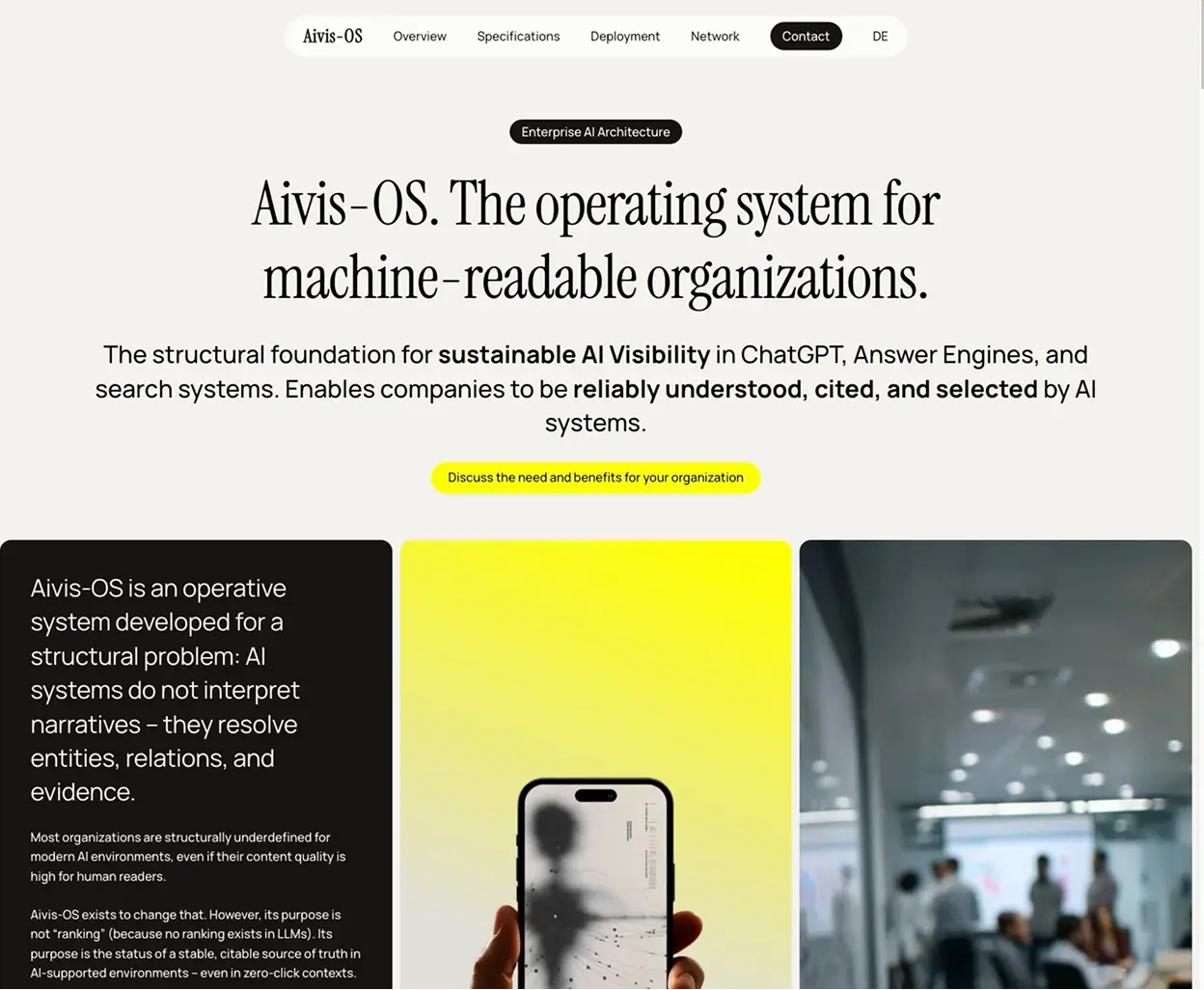
Behind this service sits AIVIS-OS (www.aivis-os.com), an advanced framework and operating system designed specifically for how large language models discover, interpret, and reuse information. While clients experience simple outcomes—being mentioned, trusted, and chosen—the underlying methodology is built on deep analysis of how AI systems crawl websites, identify brands, and decide what information is safe to cite. This includes modeling brands as structured entities, connecting them through verified relationships, reinforcing claims with evidence, and ensuring consistency across clusters of content.
You don’t need to understand entities, knowledge graphs, or AI indexing mechanics to benefit from them. What matters is that the methodology is rigorous, repeatable, and engineered for how AI systems actually work today. This depth is what separates temporary visibility from durable, compounding presence inside AI-generated answers.
AI Visibility Methodology
The offer
We’ve simplified the technical complexity into four actionable components for your business:
System Logic: Entity > Keyword
Most SEO is "spray and pray." We take a surgical approach, mapping your core services to unique Wikidata identifiers (QIDs). This eliminates disambiguation errors, ensuring that every AI model knows exactly who you are, what you do, and why you are the expert.
Outcome: Retrieval-First Design
We don't just "write content"; we build data pipelines. By serializing your knowledge into high-density JSON-LD, we decrease the computational effort required for AI bots to index you. When you make it easy for the machine to read, you make it easy for the machine to recommend.
Standard: The 10-Hour Workflow
Complexity is the enemy of execution. Our process follows a strict 10-hour implementation standard for every priority page, moving from entity inventory to forensic verification. You get a repeatable, scalable system that turns technical debt into a strategic visibility asset.
Talk to Our AI Visibility Expert
Effective AI visibility is more than just technology –
It's about understanding entities, knowledgeGraphs, Retrieval and Clusters.
Daniel Ovidiu Banica
CEO @epoint and @marketos
Any questions?
Quick answers to frequently asked questions about AI Brand Visibility
Here you find answers to the most common questions about our AI automation services. If you need more details, don't hesitate to contact us.
Haven't found your answer?
What is QID Mapping?
QID Mapping is the process of linking a proprietary digital entity (like a specific product or person on your website) to a corresponding unique identifier (Q-ID) in Wikidata. This creates a “hard link” between your local data and the global Knowledge Graph, allowing AI models to instantly verify the entity’s identity without relying on ambiguous text matching.
What is the "Disambiguation Crisis"?
A Disambiguation Crisis occurs when an AI model encounters a term that refers to multiple things (e.g., “Delta” could be an airline, a faucet, or a letter). Without a unique identifier (QID), the AI relies on probability to guess the context. If your brand is less statistically probable than a competitor or a generic term, the AI will ignore you.
How does Wikidata Synchronization work?
Wikidata Synchronization is the automated protocol of keeping your local schema tags aligned with global standards. By injecting sameAs properties pointing to Wikidata (e.g., sameAs: https://www.wikidata.org/wiki/Q123), we force the AI to treat your content as an extension of its own training data, significantly increasing trust and recall.