Automated Authority
Scaling AI visibility manually is an impossible task. We provide the enterprise-grade toolset to capture, normalize, and map your organizational knowledge for the agentic web.

No contracts. Clear verdict. Actionable next steps.
The Scaling Barrier of the New Web
Traditional SEO is often a manual, page-by-page struggle. However, AI visibility requires a level of sequence and discipline that isolated tactics cannot provide. If your technical team is manually hard-coding every entity relationship, your visibility will never keep pace with the speed of LLM training and retrieval cycles.
Without a structured toolkit, outcomes become inconsistent across teams and time. You risk creating "data silos" where different parts of your organization send conflicting signals to AI models, leading directly to hallucinations and citation loss.
A Repeatable Workflow for AI Understanding
The Aivis OS Toolset provides the technical infrastructure to ensure consistent outcomes. We replace guesswork with three core automated modules:
Capture & Clean
We normalize fragmented content from across your organization into a single, machine-readable format ready for AI analysis.
Entity Identification Workflow
Our tools scan your entire digital footprint to identify the core "knowledge nodes" that define your brand’s authority.
QID Mapping & Disambiguation
We automate the process of linking your entities to unique identifiers in the global knowledge graph, ensuring you are never confused with a competitor.
3 Steps to Scalable Visibility
System Integration
We deploy the Aivis OS toolset across your existing content infrastructure to begin the normalization process.
Automated Mapping
The system identifies and serializes your entities, creating a high-density "Truth Layer" without requiring hundreds of manual hours.
Continuous Synchronization
The toolset maintains the integrity of your signals, ensuring that as your content grows, your AI visibility grows with it.
You don’t buy visibility. You buy customers.
- AI Visibility Audit (where and how you appear today)
- Brand Mention Strategy (what AI should say about you)
- Citation Optimization (so AI repeats your name correctly)
- Competitive Visibility Map (who AI prefers today)
- Baseline Monitoring (so progress is measurable)

Daniel Ovidiu Banica
CEO @epoint and @marketos
the enterprise methodology
Powered by an enterprise-grade AI visibility framework
Brand visibility inside ChatGPT, Gemini, and Perplexity does not happen by chance. It requires a level of precision that goes far beyond traditional SEO or content marketing.
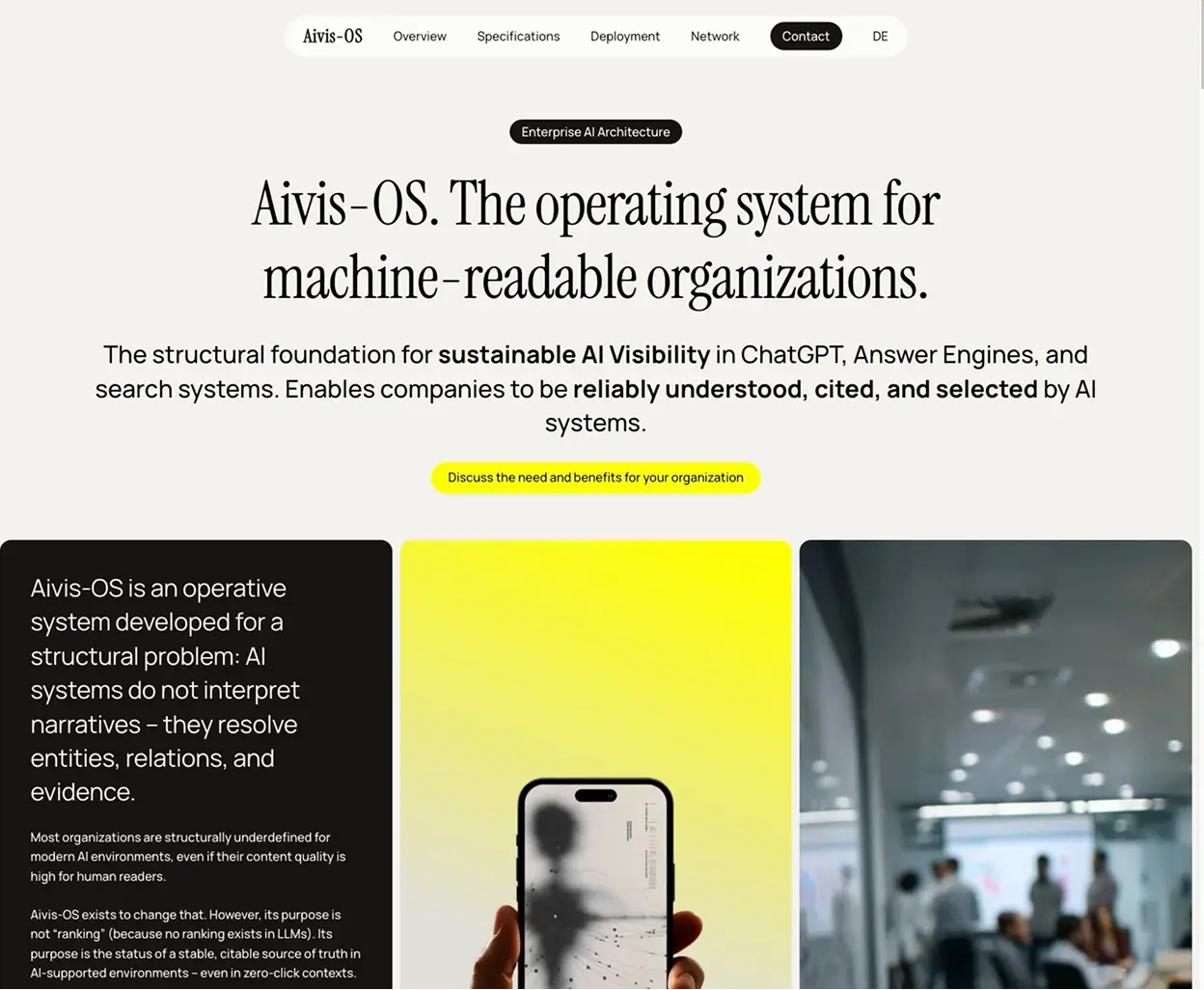
Behind this service sits AIVIS-OS (www.aivis-os.com), an advanced framework and operating system designed specifically for how large language models discover, interpret, and reuse information. While clients experience simple outcomes—being mentioned, trusted, and chosen—the underlying methodology is built on deep analysis of how AI systems crawl websites, identify brands, and decide what information is safe to cite. This includes modeling brands as structured entities, connecting them through verified relationships, reinforcing claims with evidence, and ensuring consistency across clusters of content.
You don’t need to understand entities, knowledge graphs, or AI indexing mechanics to benefit from them. What matters is that the methodology is rigorous, repeatable, and engineered for how AI systems actually work today. This depth is what separates temporary visibility from durable, compounding presence inside AI-generated answers.
AI Visibility Methodology
The offer
We’ve simplified the technical complexity into four actionable components for your business:
System Logic: Entity > Keyword
Most SEO is "spray and pray." We take a surgical approach, mapping your core services to unique Wikidata identifiers (QIDs). This eliminates disambiguation errors, ensuring that every AI model knows exactly who you are, what you do, and why you are the expert.
Outcome: Retrieval-First Design
We don't just "write content"; we build data pipelines. By serializing your knowledge into high-density JSON-LD, we decrease the computational effort required for AI bots to index you. When you make it easy for the machine to read, you make it easy for the machine to recommend.
Standard: The 10-Hour Workflow
Complexity is the enemy of execution. Our process follows a strict 10-hour implementation standard for every priority page, moving from entity inventory to forensic verification. You get a repeatable, scalable system that turns technical debt into a strategic visibility asset.
Talk to Our AI Visibility Expert
Effective AI visibility is more than just technology –
It's about understanding entities, knowledgeGraphs, Retrieval and Clusters.
Daniel Ovidiu Banica
CEO @epoint and @marketos
Any questions?
Quick answers to frequently asked questions about AI Brand Visibility
Here you find answers to the most common questions about our AI automation services. If you need more details, don't hesitate to contact us.
Haven't found your answer?
What is the Aivis OS Toolset?
The Aivis OS Toolset is a proprietary software suite designed to automate the construction of machine-readable Knowledge Graphs. Unlike manual SEO, which scales linearly with human effort, Aivis OS uses algorithmic logic to ingest, normalize, and map thousands of enterprise pages into high-density JSON-LD in a fraction of the time.
Why is Data Normalization necessary for AI?
Data Normalization is the process of standardizing inconsistent information (e.g., conflicting product specs across different PDFs and web pages) into a single, coherent format. Without normalization, AI models encounter “data friction,” leading to lower confidence scores and reduced citation probability.
How does Automated Entity Mapping work?
Automated Entity Mapping scans an organization’s digital footprint to identify potential “Knowledge Nodes” (people, products, concepts). It then cross-references these nodes against global databases like Wikidata to assign unique QIDs, converting unstructured text into a structured, disambiguated graph.