Data for Zero-Click Economy
Traditional SEO metrics are dead. We measure the structural indicators that prove your brand is the primary source for AI-generated answers.

No contracts. Clear verdict. Actionable next steps.
Why Clicks Are a Lagging Indicator
In an era where a significant portion of searches end without a click, your traditional search console provides an incomplete picture. You might be the "top result," but if an AI assistant doesn't cite you in its final narrative, you have lost the moment of influence.
The problem is a "Metric Gap." While you track clicks, the market has moved to "Answer Share". Without KPIs that measure how AI systems perceive and reuse your data, you cannot govern your brand’s reputation in the agentic web.
The New Hierarchy of Success
We have replaced vanity metrics with forensic indicators that measure your brand's structural authority:
Citation Share
The frequency with which your brand is cited as the primary source for specific industry queries across major LLMs.
Entity Density
The strength and clarity of your brand's node within the global knowledge graph compared to your competitors.
Hallucination Rate
A negative-indicator KPI tracking the percentage of AI outputs that contain distorted or unverified facts about your organization.
Retrieval Efficiency
The speed and accuracy with which an AI agent can extract a "Prompt-Ready" answer from your site's architecture.
3 Steps to Performance Governance
Metric Calibration
We define the specific "Truth Baselines" for your industry and set targets for citation growth.
Structural Optimization
We use KPI data to identify which entities are "under-cited" and apply the Aivis OS architecture to strengthen their signal.
Defensive Reporting
We provide recurring audits that prove your brand is defending its territory in the knowledge graph against competitor encroachment.
You don’t buy visibility. You buy customers.
- AI Visibility Audit (where and how you appear today)
- Brand Mention Strategy (what AI should say about you)
- Citation Optimization (so AI repeats your name correctly)
- Competitive Visibility Map (who AI prefers today)
- Baseline Monitoring (so progress is measurable)

Daniel Ovidiu Banica
CEO @epoint and @marketos
the enterprise methodology
Powered by an enterprise-grade AI visibility framework
Brand visibility inside ChatGPT, Gemini, and Perplexity does not happen by chance. It requires a level of precision that goes far beyond traditional SEO or content marketing.
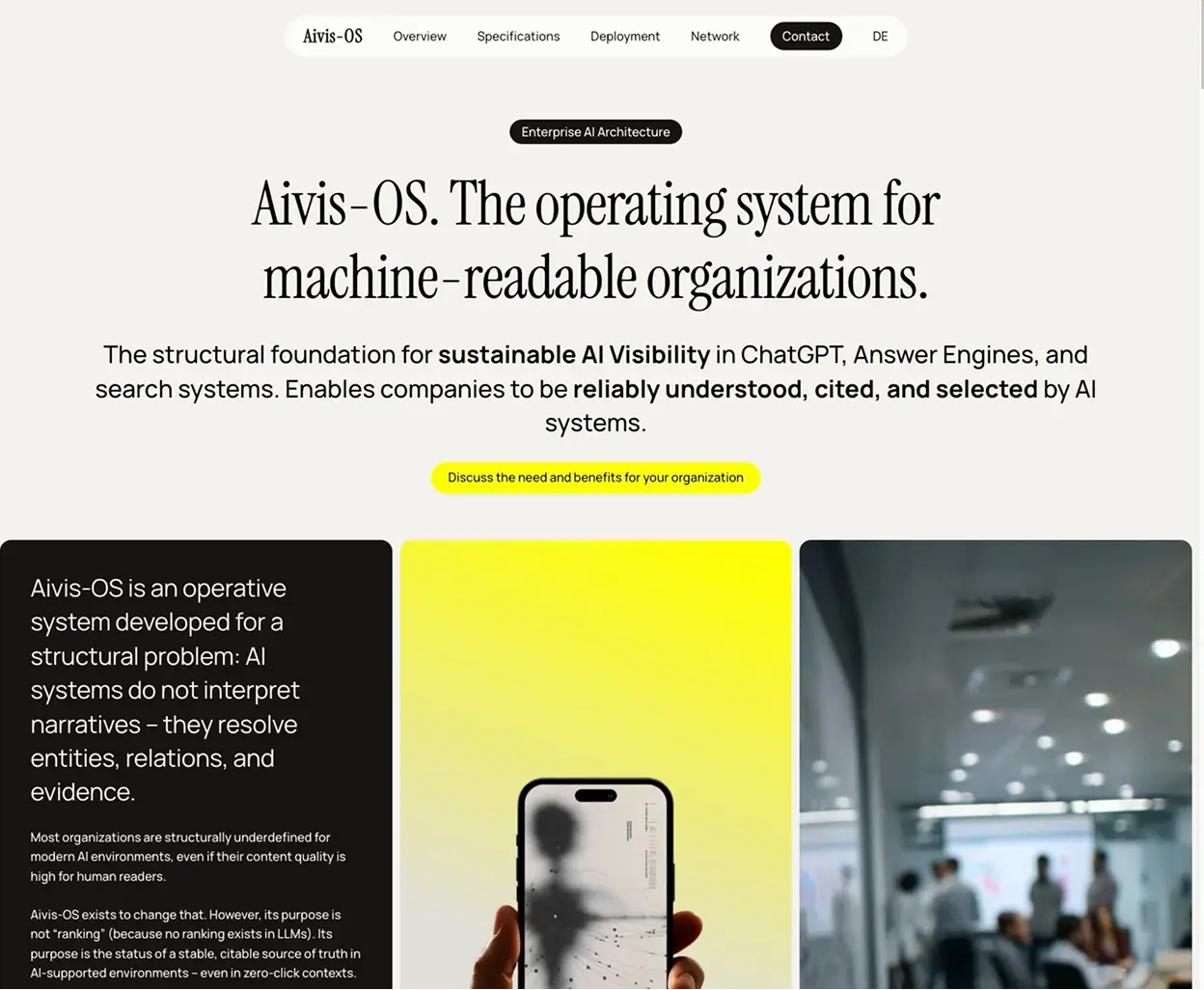
Behind this service sits AIVIS-OS (www.aivis-os.com), an advanced framework and operating system designed specifically for how large language models discover, interpret, and reuse information. While clients experience simple outcomes—being mentioned, trusted, and chosen—the underlying methodology is built on deep analysis of how AI systems crawl websites, identify brands, and decide what information is safe to cite. This includes modeling brands as structured entities, connecting them through verified relationships, reinforcing claims with evidence, and ensuring consistency across clusters of content.
You don’t need to understand entities, knowledge graphs, or AI indexing mechanics to benefit from them. What matters is that the methodology is rigorous, repeatable, and engineered for how AI systems actually work today. This depth is what separates temporary visibility from durable, compounding presence inside AI-generated answers.
AI Visibility Methodology
The offer
We’ve simplified the technical complexity into four actionable components for your business:
System Logic: Automated Validation
How do you know if the AI "gets" you? We use dual-layer monitoring—running thousands of automated prompts to see exactly how LLMs describe your brand. This isn't just tracking; it’s forensic evidence that your structural changes are shifting the model’s weights in your favor.
Outcome: Strategic Metrics
KPIs are changing. We measure "Citation Share" and "Entity Density"—the metrics that actually matter in an agentic world. You get a real-time dashboard that shows exactly where you are being used as a source and where competitors are encroaching on your authority.
Standard: Verifiable Integrity
In a world of generative noise, trust is the only currency. Our monitoring framework provides an audit trail of how your brand’s "Truth Layer" is performing across models. We turn invisible AI perceptions into actionable data points, allowing you to optimize for the future, today.
Talk to Our AI Visibility Expert
Effective AI visibility is more than just technology –
It's about understanding entities, knowledgeGraphs, Retrieval and Clusters.
Daniel Ovidiu Banica
CEO @epoint and @marketos
Any questions?
Quick answers to frequently asked questions about AI Brand Visibility
Here you find answers to the most common questions about our AI automation services. If you need more details, don't hesitate to contact us.
Haven't found your answer?
What is Citation Share?
Citation Share is the AI-era equivalent of “Market Share.” It measures the percentage of AI-generated answers for a specific industry query (e.g., “Best Enterprise CRM”) where your brand is cited as a primary source. Unlike “Share of Voice,” which tracks volume, Citation Share tracks authoritative referencing by the reasoning engine.
What is Entity Density?
Entity Density measures the richness and connectivity of your brand’s node in the Knowledge Graph. A high-density entity has clear connections to products, people, locations, and third-party authorities (Wikidata). Low density makes your brand look like “unstructured text” to an AI, increasing the risk of being ignored.
Why is Hallucination Rate a critical KPI?
Hallucination Rate is a negative indicator that tracks how often an AI model invents false facts about your brand. A rising Hallucination Rate indicates “Entity Drift”—a disconnect between your current reality and the model’s training data—requiring immediate schema synchronization to fix.