Definition Beats Description
AI systems do not read your website; they resolve entities. Stop competing with ambiguity and start building a stable identity that LLMs can cite with 100% confidence.

No contracts. Clear verdict. Actionable next steps.
Why Entities Matter for Retrieval
AI systems like ChatGPT and Claude function as reasoning engines, not search engines. When they look at your brand, they aren't looking for "keywords"—they are searching for a unique, verifiable node in their internal knowledge graph. If your brand is defined only by unstructured text, it is "invisible" to the reasoning layer.
Without clear entity definitions, your brand competes with every other similar-sounding term in the digital void. Entity architecture creates a "hard-coded" identity that ensures AI systems consistently reference your facts, your pricing, and your expertise. because it is the most reliable source available.
The Structural Shift from Pages to Nodes
Disambiguation Power
We link your brand to unique identifiers (QIDs) in global databases like Wikidata. This ensures AI never confuses your "Enterprise Solution" with a competitor's generic offering.
Semantic Consistency
By defining the relationships between your products, people, and processes, we create a web of data that AI can navigate without "guessing."without "guessing."
Retrieval-Ready Data
We transform your narrative into high-density JSON-LD, reducing the "computational cost" for an AI to understand your value.
3 Steps to Machine-Readability
Entity Inventory
We audit your existing content to identify the core "knowledge assets" that AI should prioritize.
Graph Construction
We build the schema and QID mappings that turn those assets into a machine-readable Knowledge Graph.
Active Monitoring
We use forensic prompts to verify that LLMs are correctly identifying and citing your entities in real-time.
You don’t buy visibility. You buy customers.
- AI Visibility Audit (where and how you appear today)
- Brand Mention Strategy (what AI should say about you)
- Citation Optimization (so AI repeats your name correctly)
- Competitive Visibility Map (who AI prefers today)
- Baseline Monitoring (so progress is measurable)

Daniel Ovidiu Banica
CEO @epoint and @marketos
the enterprise methodology
Powered by an enterprise-grade AI visibility framework
Brand visibility inside ChatGPT, Gemini, and Perplexity does not happen by chance. It requires a level of precision that goes far beyond traditional SEO or content marketing.
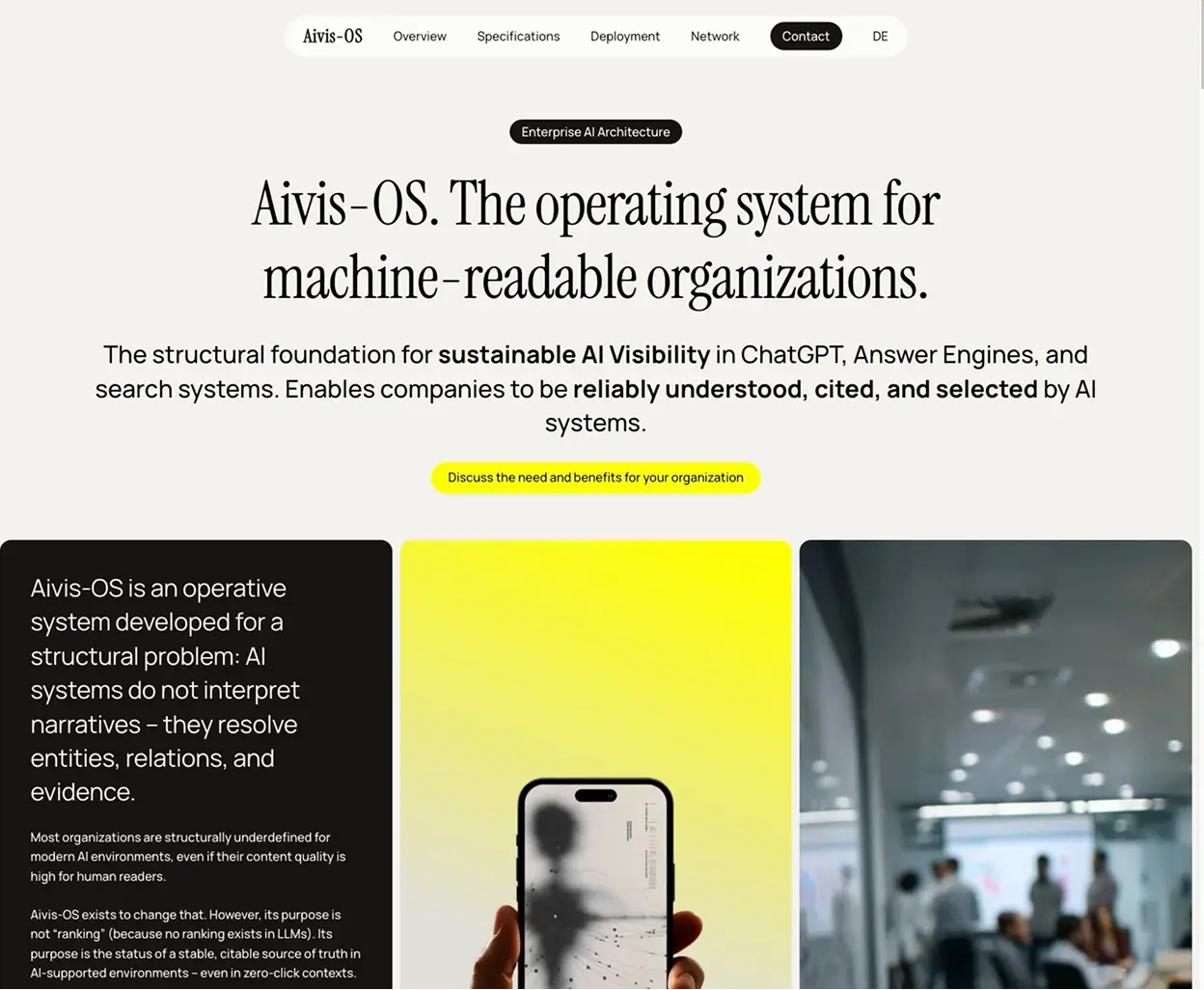
Behind this service sits AIVIS-OS (www.aivis-os.com), an advanced framework and operating system designed specifically for how large language models discover, interpret, and reuse information. While clients experience simple outcomes—being mentioned, trusted, and chosen—the underlying methodology is built on deep analysis of how AI systems crawl websites, identify brands, and decide what information is safe to cite. This includes modeling brands as structured entities, connecting them through verified relationships, reinforcing claims with evidence, and ensuring consistency across clusters of content.
You don’t need to understand entities, knowledge graphs, or AI indexing mechanics to benefit from them. What matters is that the methodology is rigorous, repeatable, and engineered for how AI systems actually work today. This depth is what separates temporary visibility from durable, compounding presence inside AI-generated answers.
AI Visibility Methodology
The offer
We’ve simplified the technical complexity into four actionable components for your business:
System Logic: Entity > Keyword
Most SEO is "spray and pray." We take a surgical approach, mapping your core services to unique Wikidata identifiers (QIDs). This eliminates disambiguation errors, ensuring that every AI model knows exactly who you are, what you do, and why you are the expert.
Outcome: Retrieval-First Design
We don't just "write content"; we build data pipelines. By serializing your knowledge into high-density JSON-LD, we decrease the computational effort required for AI bots to index you. When you make it easy for the machine to read, you make it easy for the machine to recommend.
Standard: The 10-Hour Workflow
Complexity is the enemy of execution. Our process follows a strict 10-hour implementation standard for every priority page, moving from entity inventory to forensic verification. You get a repeatable, scalable system that turns technical debt into a strategic visibility asset.
Talk to Our AI Visibility Expert
Effective AI visibility is more than just technology –
It's about understanding entities, knowledgeGraphs, Retrieval and Clusters.
Daniel Ovidiu Banica
CEO @epoint and @marketos
Any questions?
Quick answers to frequently asked questions about AI Brand Visibility
Here you find answers to the most common questions about our AI automation services. If you need more details, don't hesitate to contact us.
Haven't found your answer?
Why do Entities matter for AI Retrieval?
AI systems like ChatGPT and Claude function as reasoning engines, not search engines. They do not look for keywords; they search for unique, verifiable nodes (Entities) in their internal Knowledge Graph. If your brand is defined only by unstructured text, it remains “invisible” to this reasoning layer.
What is Entity Architecture?
Entity Architecture is the process of creating a “hard-coded” identity for your organization. It involves disambiguating your products, people, and services by linking them to unique identifiers (QIDs) and defining their relationships in a machine-readable format. This ensures AI systems consistently reference your facts rather than guessing.
How does Aivis OS build a Knowledge Graph?
We move from “pages to nodes” using a three-step process:
- Entity Inventory: We audit your content to identify core knowledge assets.
- Graph Construction: We build the schema and QID mappings to turn assets into a machine-readable graph.
- Active Monitoring: We verify retrieval using forensic prompts.