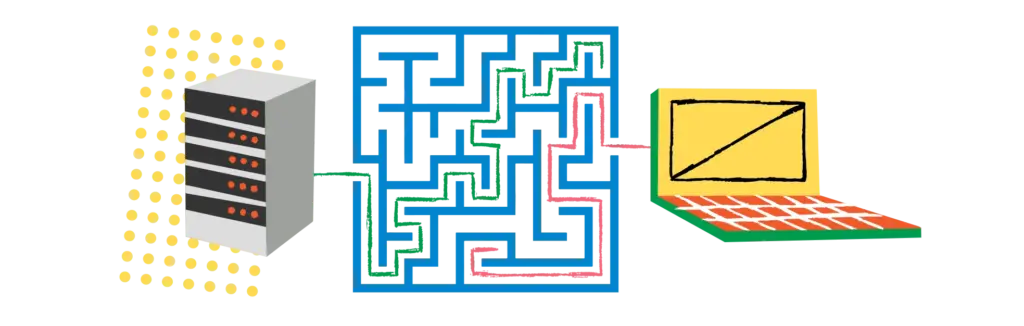


The digital world has shifted. Visibility is no longer a result of good design or clever copy. It’s a result of algorithmic selection. If machines can’t read you, you don’t exist.
Digital transformation has crossed a new threshold. Visibility on the web is no longer just the result of strategic communication; it is the result of algorithmic selection.
Companies that rely solely on classic digital marketing, beautiful websites, and general brand awareness are losing relevance. Not because their offers have gotten worse, but because they structurally cease to exist in the new ecosystem.
Systems like ChatGPT, Bing, and Perplexity are changing the very foundation of digital perception. They don’t just show links; they give answers. They don’t search for keywords; they search for meaning. And they prioritize content not based on aesthetics or popularity, but on machine interpretability.
What meant “visibility” for the last decade – ranking in Google, consistent web design, well-written text – is no longer enough. Visibility is now algorithmically generated. If you aren’t part of this new logic, you will be ignored – no matter how professional your communication is.
The visibility you trusted is now only visible to humans. To machines, you are invisible.
The Paradigm Shift: From Search to Selection
We are moving from a search-based to a system-based paradigm. Previously, users discovered content via Google. Today, AI systems deliver it. The difference is fundamental: Where humans used to click, models now decide what gets shown.
This new visibility follows a different logic. It’s not about keywords or backlinks anymore. It’s about structure, semantic clarity, and machine connectivity.
From Google to GPT: The New Gatekeepers
Systems like ChatGPT and Perplexity don’t just aggregate information; they synthesize meaning. The goal isn’t to place a website prominently; it’s to appear as a citeable source within the answer itself.
If your web development strategy doesn’t ensure you are structurally embedded, semantically linked, and systematically referenceable, these models will exclude you.
The Zero-Click Economy
More and more answers are delivered directly on the platform – without a click to your website. This means your content’s ability to be extracted, processed, and cited matters more than the content itself.
It doesn’t matter how convincing your text is if it isn’t machine-readable. If you ignore this, you won’t just get fewer clicks; you will simply stop being perceived.
What “Machine-Readable” Actually Means
Being “Findable” Isn’t Enough
Machine readability starts with structure, not indexing. Content optimized for search engines often only meets the minimum requirement of being technically findable.
But systems like GPT need more. They need structured data, semantically unambiguous statements, referenced entities, and an architecture that creates context. Relevance is no longer created by volume or repetition, but by systemic placement.
Why Classic Branding Fails Here
Most brands are visual, not semantic. They rely on design consistency, colors, and logos – parameters built for humans. But AI systems don’t see colors. They rely on logic, structure, and reference chains.
Brand management that relies on internal aesthetics is communicating past the infrastructure where relevance is created today. Only those who build semantic leadership structures -through language architecture, structured data, and contextual linking – will be perceived as a brand by machines. This requires a rethink of your entire customer experience (CX) strategy to include non-human users (bots/AI).
Entities, JSON-LD & Semantic Signals
The future of communication isn’t creative; it’s structured. Whether a brand is cited by an AI depends on whether its content is linked to clear entities, marked up with JSON-LD, and part of a semantically consistent cluster.
Language must be translated into structure. Brand identity must become algorithmically readable.
Visibility as a System Performance
AI Visibility: The New Currency
Visibility is no longer about presence; it’s about connectivity. To be found today, you must communicate in a way that machines can not only discover your content but derive meaning from it.
AI Visibility describes this shift: from findability to algorithmic prioritization. It’s not about being visible -it’s about being allowed to appear. In this new economy, semantic quality, structural readability, and systemic integration are what count.
Transactional Communication: From Visibility to Impact
Machine visibility is the ticket; impact happens afterwards. Only when content is not just indexed but also functionally designed can visibility lead to the next step: a click, a conversation, a decision.
This is where conversion rate optimization (CRO) evolves. Transactional communication means generating relevance, transferring trust, and triggering action – all in one semantic pass. The user doesn’t click because a button is flashing, but because meaning has been delivered precisely.
Data Architecture: Structure is the New Branding
Brand management in the AI age needs a different foundation. Not design guidelines or campaign routines, but data architecture: a structured system that sorts content semantically, models it technically, and links it contextually.
Branding becomes an architectural feat. And visibility becomes the result of clear order.
Strategic Consequences: How to Adapt
How to Know if You Are Visible to Machines
You can’t answer this with Google rankings or traffic numbers. Visibility in the AI world means appearing in answers. Ask the systems themselves – ChatGPT, Perplexity, Bing.
If your brand name or offer doesn’t appear, it’s not an accident; it’s a structural deficit. Look at the technical foundation: Does the website use structured data? Are people, services, and entities correctly marked up?
What You Must Change Tomorrow
- Double Address: Communication must be addressed to both humans and machines.
- Architecture: You need a logic that structures content semantically and models it technically.
- Break Silos: Marketing, SEO, UX, IT- they often work in isolation. Machine visibility only happens when language, structure, and AI automations interlock.
Speed Through Structure
Visibility can be generated in record time today – if the system is right. Articles that are clearly structured and semantically precise can appear in AI systems like Perplexity within minutes. Not just anywhere, but as the #1 source.
This isn’t luck; it’s order. Structure enables immediate impact because it is connectable for machines.
Conclusion: Lead Your Brand in a System That Doesn’t Know You
Communication isn’t changing because humans are changing – but because the infrastructure of their perception is changing. If you want to remain visible, you must understand that attention is no longer earned; it is algorithmically assigned.
What starts as digital progress ends as a strategic imperative: Only those who are machine-readable remain part of reality.
This isn’t a threat; it’s an opportunity. The tools are there: structured data, semantic models, transactional architecture. Companies that act now don’t just regain visibility. They create a new form of brand management- precise, connectable, systemic.
Readable for machines. Relevant for humans.